
Materials explainer · U.S. safety context
Published September 23, 2026 · Manufacturer and U.S. agency sources listed below
What Are Fuse Beads Made Of?
What are fuse beads made of? Perler identifies its beads as LDPE, and Hama identifies its beads as PE, but a bead, pegboard, and storage box in the same kit may use different plastics. Here is what PE, LDPE, PP, PVC, and PPE mean—and how to evaluate claims about formaldehyde, fumes, and U.S. product safety.
See the material comparisonThe documented answer
Check the component, not just the kit label
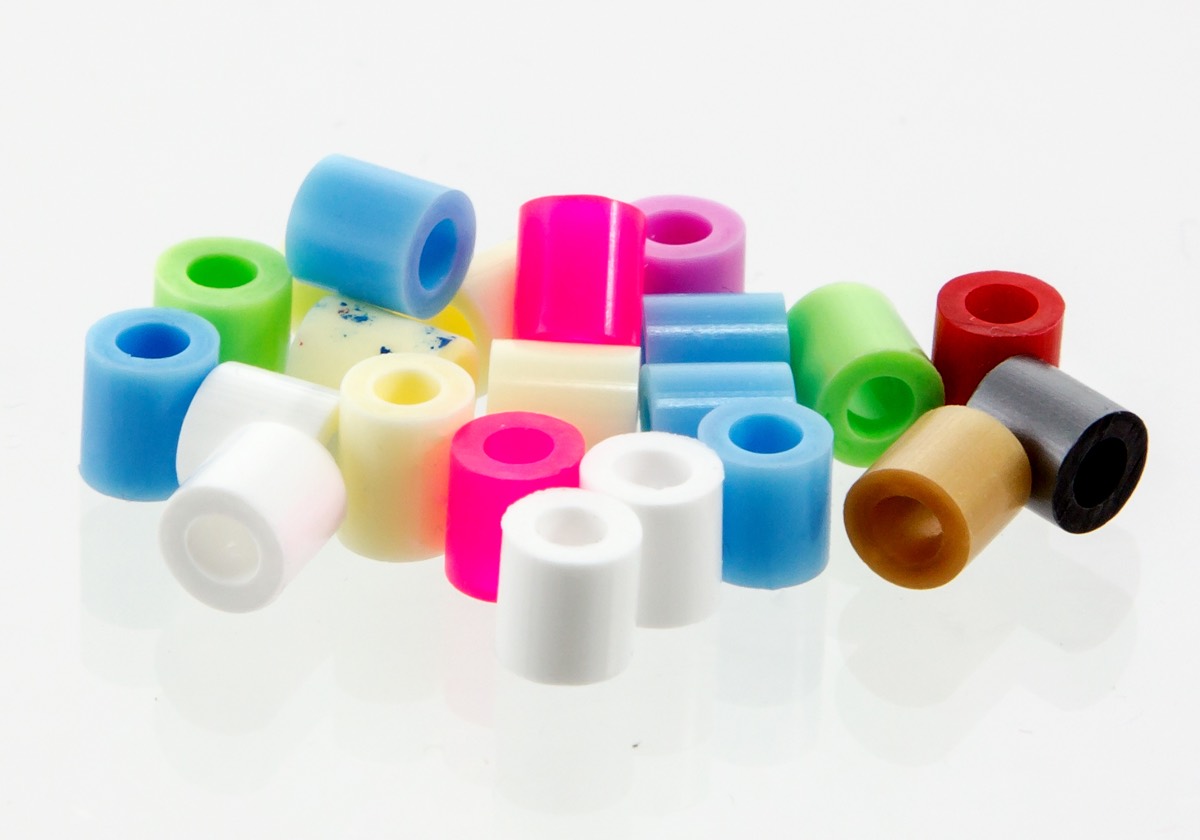
Perler says its beads are LDPE, a low-density form of polyethylene. Hama’s material sheet identifies its beads as PE, while listing PP for some boxes, lids, and bead supports and PS for pegboards and trays. The letters printed on a container may therefore describe the container rather than the beads inside.
These are manufacturer disclosures for those products, not a laboratory finding about every fuse bead sold in the United States. If a listing does not identify the bead material, ask the manufacturer for the specific product’s material information.
Read the abbreviations
PE, LDPE, PP, PVC, and PPE are different labels
| Label | Full name | What the verified sources say here |
|---|---|---|
| PE | Polyethylene | Hama identifies PE as its bead material. |
| LDPE | Low-density polyethylene | A type of PE; Perler identifies LDPE as its bead material. |
| PP | Polypropylene | Hama lists it for some packaging and bead supports; that does not mean the beads are PP. |
| PVC | Polyvinyl chloride | Hama says it changed its bead raw material from PVC to PE in 1989. Check any current product individually. |
| PPE | Polyphenylene ether, in a plastics context | A different abbreviation from PP or PE. Do not infer that a fuse bead is PPE without product documentation. |
Sources: Hama material sheet, Perler FAQ, Hama history, and SABIC’s PPE terminology.
The formaldehyde question
Do fuse beads contain or release formaldehyde?
A polymer name alone cannot establish a product’s measured formaldehyde content or emissions. PE is not a formaldehyde-based resin, but pigments, additives, manufacturing, and heating conditions are product-specific. Without a test report for the exact product and use condition, it would be unsound to promise “zero formaldehyde” or to claim that ordinary fusing produces a particular exposure level.
The U.S. EPA’s well-known TSCA Title VI formaldehyde rule addresses certain composite wood products made with resin adhesives, including hardwood plywood, MDF, and particleboard. It is not a fuse-bead certification. A seller citing “TSCA Title VI compliant” as proof of a bead’s formaldehyde emissions is applying a wood-product rule to the wrong material.
If formaldehyde is a deciding concern, request a product-specific test report that names the measured substance, test method, sample, and conditions. A generic “non-toxic” badge or a report for a different kit cannot answer that question.
Heating matters
Follow the fusing instructions and avoid scorching
Iron-fuse beads are intended to soften enough for neighboring beads to join. That is different from holding a hot iron in one spot until the plastic smokes or chars. Perler’s standard instructions call for ironing paper over the design, a household iron on medium, continuous movement, and adult handling. Its FAQ recommends a small test patch and adjusting heat if the beads are not joining or their holes are closing too quickly.
Use the product’s own directions, work in a normally ventilated area, and stop if the plastic scorches. A smell is not a chemical test: it cannot identify formaldehyde or prove its absence. If a manufacturer publishes emissions data, compare the stated test conditions with actual ironing rather than treating a room-temperature material certificate as a heating test.
U.S. safety language
What do ASTM F963, CPSIA, and “non-toxic” tell you?
For products that qualify as children’s toys, the U.S. Consumer Product Safety Commission explains how ASTM F963 and other requirements apply, including limits for lead and specified phthalates. Product classification matters: the CPSC’s toy guidance excludes some hobby and craft items whose finished item is not primarily of play value from its toy definition. Do not assume that every craft refill bag follows the same toy-testing route as a kit marketed as a children’s plaything.
A Children’s Product Certificate, when required, is issued by the manufacturer or importer and is not required to be handed to a retail consumer. Its absence from a product page does not itself prove noncompliance. Conversely, a vague “CPSIA certified” line without a product identity or applicable test details is weak evidence. Ask the seller for a manufacturer name, model or SKU, applicable standard, and product-specific documentation.
“Food-grade,” “BPA-free,” and “non-toxic” answer different questions, if they are substantiated at all. Perler calls its LDPE food-grade in its FAQ, but that does not turn finished crafts into food-contact items or establish every possible chemical result for every brand. Use such claims as prompts for documentation, not a substitute for age guidance or proper ironing.
The everyday risk
Small parts and a hot iron deserve attention too
Loose beads are small parts. The CPSC small-parts guidance explains the choking concern for children under three and the warning-label rules for certain children’s products. Keep spilled beads out of reach, especially when an older child is crafting near a younger sibling. Follow the age label for the exact kit.
Only an adult should handle the iron, as Perler’s instructions state. Do not touch the beads or pegboard directly with the iron. Let the piece cool before handling it.
Practical conclusion
A five-point check before you buy
- Find the bead material for the exact product—not merely a recycling mark on its box.
- Read the age label and small-parts warning; keep loose beads away from children under three.
- Identify the bead size and matching board before comparing prices or color counts.
- Ask for a relevant, product-specific report if a chemical claim matters to you.
- Follow the maker’s fusing directions, with an adult operating the iron.
Once you know what the labels mean, use the U.S. fuse bead buying guide to choose sizes, palettes, boards, and kits. For the next step at the craft table, follow the detailed ironing guide.
Professional references
Sources and scope
Manufacturer pages establish what those manufacturers disclose about their own products. CPSC and EPA pages explain U.S. regulatory scope. None of these sources is a laboratory measurement of every fuse bead on the market.
- Perler: Frequently Asked Questions: LDPE material and fusing
- Hama: Material information: beads, pegboards, and packaging
- Hama: The story of Hama: 1989 change from PVC to PE
- Perler: Standard fusing method
- U.S. Consumer Product Safety Commission: Toy safety FAQ: lead, phthalates, ASTM F963, and testing
- U.S. Consumer Product Safety Commission: Toy safety business guidance: the craft-item scope distinction
- U.S. Consumer Product Safety Commission: Children’s Product Certificate FAQ
- U.S. Consumer Product Safety Commission: Small parts and choking hazard labeling
- U.S. Environmental Protection Agency: Formaldehyde standards for composite wood products: consumer FAQ
- SABIC: NORYL resin information identifying polyphenylene ether as PPE